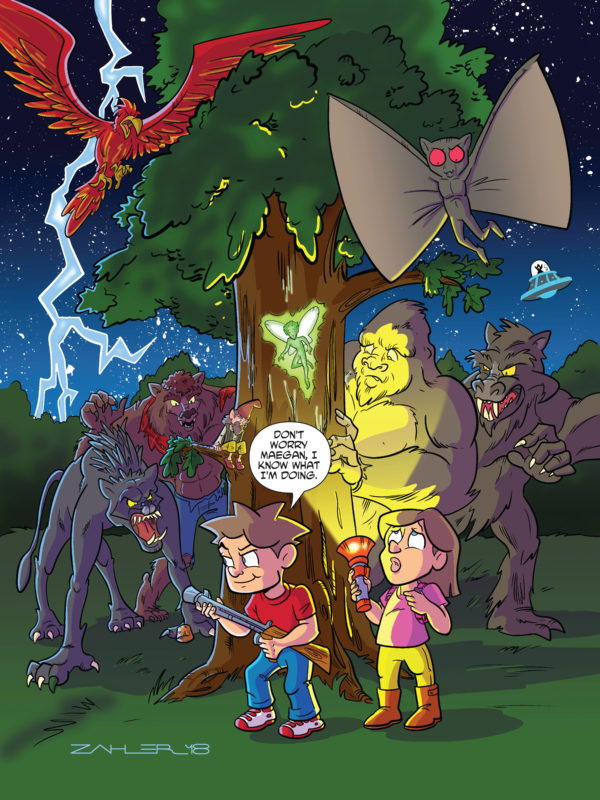

Getting kids engaged in school work can be a difficult task, to say the least. Teachers are constantly attempting to find new and interesting ways to gets kids thinking and learning. Here's something fun: Kids who groan about reading a history chapter will happily spend an hour arguing about whether a four-foot hairy creature steals apples in the Pennsylvania woods.
That creature is the Albatwitch, a small Bigfoot-like legend from the woods around Chickies Rock, a cliff on the Susquehanna River near Columbia, Pennsylvania. It's said to live in the trees, snatch apples from picnickers, and sometimes throw the cores back at them. (If you want the full backstory, I covered the legend and the sightings in my last post.)
This post is for the grown-ups: parents, classroom teachers, and homeschool families looking for something that gets kids reading, thinking, and writing without feeling like a worksheet. A good cryptid legend turns out to be a surprisingly useful teaching tool, and the Albatwitch is one of my favorites.
Why cryptids work so well for learning
A cryptid is an animal that some people believe exists but science hasn't confirmed. Bigfoot, the Loch Ness Monster, and Mothman are the famous ones. The Albatwitch is a smaller, local legend, which actually makes it better for teaching. There's a lot to dig into without it being overwhelming.
Here's why legends like this work:
- Built-in curiosity. Kids want to know if it's real. You don't have to manufacture interest. It's already there.
- No answer key. Nobody has proven the Albatwitch exists or doesn't. That gives kids room to form their own opinions and defend them, which is where real thinking happens.
- Story versus evidence. Cryptids are a low-stakes way to practice a high-stakes skill: telling the difference between a good story and good evidence. That skill carries over to news, advertising, and everything they'll read online.
- Real history, real places. The Albatwitch shows up in Lancaster County newspapers as far back as 1920. Chickies Rock is a real park you can visit or find on a map. Kids aren't just reading about a monster. They're reading about a place and the people who lived there.
The goal isn't to convince kids that monsters are real, or that they're not. It's to teach them how to ask questions and go looking for answers. That's what a young cryptozoologist does.
One legend, every subject
The nice thing about a single legend is that you can come at it from almost any direction. Here are some ideas, organized by subject. Pick one, or string a few together into a week-long unit.
Reading and language arts
- Read a few different accounts of the Albatwitch and compare them. Which details stay the same? Which ones change from source to source?
- Talk about where the name might come from. The popular theory is that it's Pennsylvania Dutch for "apple snitch," meaning apple thief. Others think it comes from a German word for elf. This is a great doorway into how words travel and change between languages.
- Discuss what makes a legend different from a myth, a fairy tale, or a tall tale.
History and social studies
- Look at when the legend first shows up in print. Local newspapers in the 1920s mention Scouts going on "Albatwitch hunts," which sounds a lot like a snipe hunt prank. Why might people have played jokes like that?
- Learn about the Susquehannock people, who lived along the river long before European settlers, and the Pennsylvania Dutch settlers who came later. How do different groups shape the stories a place tells?
- Explore how small towns like Columbia celebrate local legends today with festivals like Albatwitch Day.
Science
- Study eyeshine. Many reported sightings include glowing eyes. Raccoons, deer, foxes, and owls all have a reflective layer in their eyes that bounces light back. Which local animals could explain a sighting at night?
- Research what real animals live in the woods along the Susquehanna, and what they eat. Do any of them like apples?
- Practice the scientific method. If you wanted to prove or disprove the Albatwitch, what would you need? What would count as good evidence?
Geography
- Find Chickies Rock, the Susquehanna River, Columbia, and Wrightsville on a map.
- Trace the river from New York to the Chesapeake Bay. Why do rivers make good homes for animals (and legends)?
- Look up a topographic map of the area. Where would a small creature hide?
Writing and art
- Have kids design their own field guide page for the Albatwitch, with a drawing, size, habitat, diet, and behavior.
- Write a newspaper article reporting a sighting, complete with a headline and witness quotes.
- Invent a brand-new local cryptid for your own town, with a name, a legend, and a reason it exists.
A mini study guide to get you started
In my books, I include Words to Know, Discussion Questions, and Write Your Own writing prompts. I wanted to do the same for this post, so here's a short Albatwitch study guide you can use right away. It follows the same format as the guides that come with my books, so it doubles as a little preview of how those work.
Words to know
| Word | What it means |
|---|---|
| Cryptid | An animal some people believe in, but science hasn't confirmed |
| Cryptozoology | The study of animals that haven't been proven to exist |
| Legend | A traditional story, sometimes based on real events, that people pass down |
| Folklore | The stories, beliefs, and customs shared by a community |
| Eyewitness | A person who says they saw something happen |
| Evidence | Facts or information that help show whether something is true |
| Skeptic | Someone who questions claims and wants proof before believing |
| Eyeshine | The glow in an animal's eyes when light reflects off the back of them |
| Habitat | The natural home of an animal or plant |
| Hominid | A primate that walks upright, like humans and great apes |
Discussion questions
- Why do you think the Albatwitch legend has lasted for more than 100 years?
- Many sightings describe glowing eyes in the dark. What else could explain that?
- Some early "Albatwitch hunts" may have been pranks. Does that make the legend more or less interesting to you? Why?
- What's the difference between an eyewitness story and evidence? Can a story ever count as evidence?
- If the Albatwitch were real, why might it be so hard to find?
- Why do you think towns hold festivals for creatures that might not exist?
Writing prompts
- You're on a picnic at Chickies Rock when your apple disappears. Write what happens next.
- Write a diary entry from the Albatwitch's point of view. What does it think of all the people looking for it?
- You're a reporter in 1920 covering a Scout "Albatwitch hunt." Write the article.
- Make a field journal entry for an investigation: date, weather, location, what you saw and heard, and what you think it means.
- Convince a skeptic that the Albatwitch is real. Then switch sides and convince a believer that it isn't.
Where the Oddish Questors come in
This kind of learning is exactly why I write the Oddish Questors books. They follow a group of kids who chase strange legends, argue about the clues, and figure things out together. Each kid thinks differently. Conor is serious and wants the facts. Cera thinks about the tech to help prove something. Madelyn sees the world through eyes that take in the magic. And Mason - well, Mason tries hard to remember to put on pants. That gives young readers lots of ways to see themselves in the story, and lots to talk about afterward.
They work for a classroom unit, a homeschool literature block, or just a parent who wants to talk with their kid about what they're reading. The Bigfoot Case pairs especially well with an Albatwitch unit, since the Albatwitch is often called Pennsylvania's "little Bigfoot."
Raising young cryptozoologists
When I talk about raising young cryptozoologists, I don't mean kids who believe every story they hear. I mean kids who notice things, ask "how do we know that?", keep notes, and go looking for answers. Kids who can enjoy a spooky legend and still think clearly about it.
These kids have their imagination sparking. Wanting to go in the woods to look for cryptids is something they see as magical. That combination of imagination and investigation is a great skill to build in a kid. It makes them better readers, better writers, and better thinkers. And it's a lot more fun when there's a mysterious apple thief involved.
If you try any of these activities with your kids or students, I'd love to hear how it went. Let me know what theories they come up with. I have a feeling some of them will be better than the experts'.
albatwitch day festival, author school visit, eastern york middle school, eastern york school district, educators, homeschool, homeschool curriculum, homeschooling, learning, middle school, middle school english, middle school learning, parent teacher, pennsylvania school, reading, susquehanna, teachers, teaching resources, using cryptids in the classroom, wrightsville elementary school, wrightsville pennsylvania, writing